

Venkkat G. Krishnan
Download PDF
May 7 2025
0
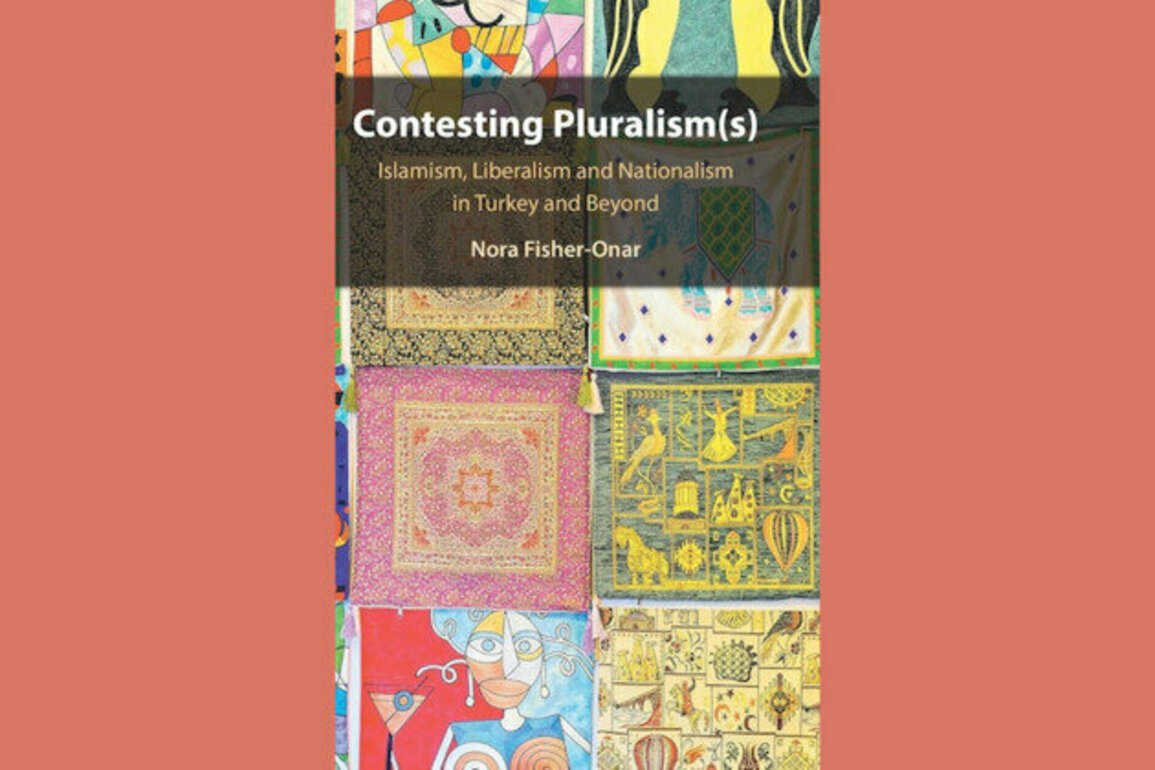
viewsImage by Cambridge University PressContesting Pluralism(s): Islamism, Liberalism, and Nationalism in Turkey and Beyond
By Nora Fisher-Onar
Cambridge University Press, 2025
It was during my first visit to Istanbul, Turkey, for a conference last year that I got to personally experience the existential dilemmas of a country at a crossroads in its eternal quest to define and redefine itself. The contradictions were evident and appeared as stark binaries night clubs serving alcohol, burqa-clad women walking right past them, jersey-wearing teens cheering for the Turkish national football team, and Syrian refugee moms with kids, begging for their survival. But in the midst of all these apparent contradictions, there somehow was a sense of mutual conciliation and harmony that kept the pluralistic nature of the city alive and thriving.
It is this puzzle that Nora Fisher-Onar attempts to make sense of in her recent book, Contesting Pluralism(s) (2025). The book challenges the conventional wisdom that a binary contest between Islam vs. democracy or secularism is the driving force in Turkeys politics. Pointing out the limitations of such hard, identitarian binaries in explaining real-world outcomes, she introduces the two cross-camp coalitions built around pluralizers (who strive for greater pluralism in society) versus anti-pluralists (who espouse the desire for a more unitary national project) as an analytical framework to trace the evolution of the political trajectory in Turkey and beyond. This is established through the use of rich empirical data of the history of political contests, starting from the late Ottoman period all the way to the present. The book evaluates the Turkish political narrative as a series of cross-camp coalitions of pluralizers that periodically take on the anti-pluralists who want the Others to look or speak, love or believe like they do (Fisher-Onar 2024:1).
Fisher-Onar starts off with the story of the 2016 military coup and the cross-party coalition that came together in support of the democratically elected leader of the AK Party Recep Tayyip Erdoan. Pointing out the growing discontent with the frameworks espousing hard Islam versus Western binaries, both Orientalism and Occidentalism alike, she proceeds to examine the three waves of intellectual engagements within inter-disciplinary Turkish studies to evaluate these binaries and their limitations. The first wave, which the book terms pursuit of parity, closely aligns with the social engineering initiated during the initial decades of the Turkish Republic under the umbrella rubric of Kemalism, which sought to transcend Orientalism by performing Westernness and downplaying its Ottoman-Islamic inheritance. Disillusionment with this approach soon gave rise to the second wave towards the second half of the twentieth century, termed recognition of difference, which manifested in the form of post-Kemalist attempts to rediscover Turkeys Ottoman-Islamic past, and emphasised its authentic cultural differences with the West, closely resembling the ideological strain of Occidentalism (Fisher-Onar 2024:194).
Fisher-Onar (2024:21) classifies her work under the third category of literature, which involves making sense of complexity by rejecting both the Orientalist/Occidentalist binary tropes definitive of the initial two waves. She re-iterates that the terms secular and Islamic have increasingly become empty signifiers misappropriated in ones search for hegemony and power consolidation amidst Turkeys turbulent political climate (2024:23). According to her, since the late Ottoman period, only rarely have the political contests in Turkey actually pitted Islamists versus secularists. Rather, political change is driven by shifting alignments of pluralizers and anti-pluralists across inter- and intra-camp alliances, and betrayals. To be sure, Fisher-Onar (2024:35) uses the term pluralism bereft of any cultural baggage as attached to the debates within Western political theory rather, pluralism is simply defined in terms of a basic willingness to share space with one or more Other(s). Fisher-Onar (2024:32) calls for a more pluralistic approach to pluralism, going beyond the conventional theorizations built on the model of Western liberal democracies a bottom-up approach that strives to close the gap between theory and practice as proponents of new pluralism insist.
The book further proceeds to delineate the twin analytical toolkits developed to aid a comprehensive re-reading of Ottoman and Turkish politics as a tale of contested pluralism(s). The first toolkit maps the pluralizing/anti-pluralist orientations (x-axis) vis--vis the role of public religion (y-axis) (see Fig 2.1, p.38). Within this, while the various strands of ethno-religious nationalism are placed towards the anti-pluralist end of the spectrum, Islamo-/secular- liberalism is placed towards its pluralizing end. In the second toolkit, the book adopts institutionalist approaches to map the complexities of the political system formed through an interaction amongst the ideational, agential, and contextual/structural parameters conceptualized (see Fig 2.2, p. 47). This framework, in addition to the reductionist attribution associated to the causal force of ideas alone (such as Islamism, liberalism, and nationalism), also takes into account the role of actors (within institutions such as political parties, bureaucracies, militaries, businesses, civil societies, etc.) and the regional and global structures (micro such as electoral rule; meso such as a countrys political regime; and macro such as global capitalism) that shape political outcomes.
The book proceeds to retell Turkeys story from the late Ottoman period to the present as a tale of competing pluralizing versus anti-pluralist coalitions. It starts off with what it terms the long nineteenth century, which saw pluralizing coalitions of Islamo-liberalism in its Tanzimat and Young Ottoman expressions between 1839 until 1868, followed by a third pluralizing coalition of disparate Young Turks who attempted to restore constitutionalism and multicultural Ottoman patriotism from 1908 until 1913 (Fisher-Onar 2024:61). This was interspersed with periods of anti-pluralist tendencies in the form of Hamidian pan-Islamism between 1878 to 1908, and the Young Turk triumvirates pan-Turkism between 1913 and 1918. The phase of the short twentieth century soon followed with the establishment of the Turkish republic in 1924, which initially saw the emergence of an ethno-nationalist regime under the banner of Ataturkism. While the shift towards a multi-party democracy in the 1950s paved the way for the possible emergence of a pluralizing coalition, Turkeys politics was thenceforth interspaced with intermittent phases of anti-pluralist coalitions formed under various strands of ethno-religious nationalism or Turkish-Islamic Synthesis.
Fast forwarding to the twenty-first century, the book traces initial attempts at forging an Islamo-liberal pluralizing alignment during the AKPs first term in government between 2002-2007, by gathering moderate religious and secular actors with the overlapping goal to align Turkey with economic globalism and the EUs project of political liberalization. Towards the end of the initial decade however, the more anti-pluralist faction within the AKP gained prominence culminating in Erdogans pivot from a EU-niversalist frame of reference to that of neo-Ottomanism around 2013 (Fisher-Onar 2024:178). While the initial trends of religious populism still provided moderate spaces for realizing ethnic plurality, a series of events such as the intra-Islamist clash of the early 2010s, and the collapse of peace processes with the Kurds, led to an evident shift towards ethno-religious nationalism by 2016. This alliance of Islamist and secular nationalists, which Fisher-Onar (2024:254) coins Turkish-Islamist Synthesis 2.0, has entrenched Turkeys illiberal turn towards an anti-pluralist incumbency at the time of writing. However, she asserts hope in the books framework by implying that under the right conditions, ideas and actors may coalesce into renewed coalitions for pluralism.
That being said, it is important to note that attempts to locate the so-called pluralizing coalition between Islamo-liberals and secular-liberals within the same ontological plane under the ambit of pluralism would inevitably lead to the re-invention of hegemonies of the one-world assumptions of Western modernity in stark contrast with the decades of decolonial many worlds critique that have come about. This was precisely what Ahmet Davutoglu talks about in his 1993 conceptualization of the differences between Western and IslamicWeltanschauungsas being paradigmatic in nature, rather than merely historical or institutional, with the ontological proximity of the former contrasted with the ontological differentiation of the latter. Similarly, due caution has to be taken when applying the conceptual framework of pluralism to an Islamic context. Instead, it is more appropriate to acknowledge an alternative logic of pluralism rooted within the Islamic tradition as traced by its hermeneutical interpretations when questioning with the Other, asnotedby SherAli Tareen (2023: 35).
With these caveats, I believe that Contesting Pluralism(s) is a timely intervention in dismantling both the hegemonic Oriental and Occidental binaries that have pitted Islamists versus secularists in Turkey, as well as in the Muslim world in general which has, in turn, facilitated misappropriation by actors across both camps in their own attempts at power consolidation centred around a unitary political identity. Instead, Fisher-Onars framework of cross-camp coalitions built around pluralizers versus anti-pluralists offers a much more nuanced conceptual lens to capture the complexities surrounding the operation of political outcomes through an interplay between ideational, agential, and structural parameters in the case of Turkey and beyond. This is particularly significant, given that Turkey is set to play a greater role in regional politics with the recent overthrow of the Iran-backed Assad regime in Syria by the Turkish-backed fighters belonging to the Syrian National Army and Hayat Tahrir al-Sham (HTS) throwing open the debates surrounding ethno-religious nationalism in Turkey to a whole new dynamic.
References
Davutoglu, A. (1993). Alternative Paradigms: The Impact of Islamic and Western Weltanschauungs on Political Theory (1st ed.). University Press of America.
Tareen, S. (2023). Perilous Intimacies: Debating Hindu-Muslim Friendship After Empire (1st ed.). Columbia University Press.
Further Reading on E-International Relations
- Review Embattled Dreamlands: The Politics of Contesting Armenian, Kurdish and Turkish Memory
- Review Pluralist Democracy in International Relations
- Review Erdoans Empire: Turkey and the Politics of the Middle East
- Review Contesting the Global Order
- Review The Rise and Fall of Peace on Earth
- Review Hotels and Highways
About The Author(s)
Venkkat G Krishnan is a doctoral candidate at the Jindal School of International Affairs, O.P. Jindal Global University, Sonipat, India. His research interests lie at the intersection of religion and International Relations (IR) theory, focusing on its ontological and epistemological contours. He is passionate about discussions centred around the theological, philosophical, and mythological dimensions of world religions. He can be reached via email at:[email protected]
Editorial Credit(s)Lakmalie Wijesinghe
TagsDemocracyIslamLiberalismPluralismTurkey